Historic Fayette Theatre
This was the official website for the Historic Fayette Theatre which offers quality, year round entertainment for the entire family.
Content is from the site's 2004 archived pages.
For the most up-to-date information about the Historic Fayette Theatre go to their facebook page at: www.facebook.com/HistoricFayetteTheater/.
2017 marks the 25th year, of the award winning Historic Fayette Theatre.
The theater is located at 115 South Court Street in the Fayetteville's Historic District, one mile south of the New River Gorge Bridge.
Historic Fayette Theatre
115 South Court Street
Fayetteville, WV 25840
Tickets and Info:
(304) 574- 4655
Theatre Construction
The Historic Fayette Theatre has a very rich and deep history.
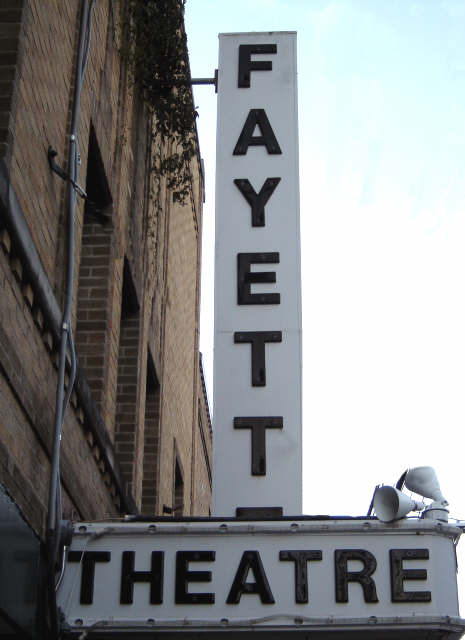
From the pages of the Fayette Tribune on October 8th, 1937.
Work On Theatre Definite
Work on the first modern theatre building Fayetteville has every had will definitely get underway prior to November 1, weather permitting. The construction will be completed as rapidly as possible, it was stated this week by C.O. Janutolo, local contractor and builder, who will be the co-owner of the new structure, together with F.G. Janutolo.
The building is to be constructed on the lot adjoining Hawkins Dress Shop here, or almost directly across the street from the present post office.
Announcement that such a building would be built was made by the Janutolos some weeks ago, but at that time it was not known definitely when work would get underway.
The building is to be completely modern in every respect, and of fireproof construction. Plans indicate it will seat approximately 400 persons, and the very latest in interior and exterior finishing will be employed to make it entirely up-to-date.
The plans indicate that no theatre in the county will be better equipped, and none made more comfortable for the patrons.
In addition to the actual theatre, which will comprise by far the larger part of the building, two small shops are to be constructed in the front, one on each side of the entrance, facing directly on the street.
While no announcement has been made as to who will lease the new structure, it was learned definitely that terms have been agreed upon and the formal announcement is expected within a comparatively short time.
It was also indicated that in providing equipment such as seats, sound system, and other features the lessee is planning an expenditure of approximately $10,000, and will spare no cost in making this equipment conform to the modernity of the building itself.
Fayetteville has never had a modern theatre building. Believed by many to be an excellent location for a good theatre, still construction has been delayed for one reason or another until this definite move by the Janutolos.

Theatre Opened
As from the pages of the Fayette Tribune, December 16th, 1938.
Modern Playhouse Will Be Opened Tuesday, December 20
The Fayette Theatre, Fayetteville's modern new playhouse, located directly on Main Street here, will be opened for business on Tuesday, December 20, it was announced today by Grant Thomas, owner and manager of the establishment.
The opening of this theatre marks a new high in Fayetteville development, and is a huge link in the building process which got underway about two years ago.
Completely modern in every respect, the show house will accommodate some 500 persons.
Construction of the new building, which is owned by Janutolo and company here, was begun early this year, and has continued through the summer months. The building is of native stone, and in addition to housing the theatre, also has small shops, one located on each side of the entrance to the theatres. One is now occupied by the Tony and George lunchroom.
The finest equipment obtainable has been installed in the theatre by Mr. Thomas, with the seats, fixtures, and sounds equipment all being in that category. Heavy carpeting makes the floor entirely soundproof.
In addition to the main floor of the theatre, two balconies are also provided, and each is equipped with the same furniture as the main section. One, for colored people, is reached by steps direct from the entrance while the other is accessible from an inside stairway. Each provides a complete view of the stage from any seat.
Fayetteville's largest neon sign presents the theatre to the public, a huge "FAYETTE" being visible from any point on the part of Route 19-21, which touches the city.
The theatre will open by presenting "That Certain Age," Mr. Thomas said.
Fayette County Historical Society
A tradition of Service & Dedication
For 73 years, the Fayette County Historical Society has stood as a symbol of the dedication of Fayette County men and women to see their history preserved for future generations. Today, the Society continues to work toward that goal with enthusiasm and determination.
The Society can trace its beginnings to the foresight of two Fayette County educators who recognized the need to record the early history of the area while it was still available. These two men were J.T. Peters and H.B. Cardin. Their plan was to compile and publish the first comprehensive History of Fayette County and to use this publication to preserve the information which lived on only in the memories of the few remaining early settlers.
Fortunately, Peters and Cardin soon discovered that they were not alone in their belief that an effort needed to be made to preserve and record the history of the area. By 1920, they had interested 24 other citizens of the county in their project. These men recruited their support to the newly formed Fayette County Historical Society.
J.T. Peters was elected to the office of President, with H.B. Cardin to serve as Secretary for the new organization. The very first project undertaken by the new group was to research, write, and publish a History of Fayette County. The task which Peters and Cardin had agreed to undertake was an enormous one but they tackled the challenge with energy and an amazing dedication to research. The was no previous written record for them to consult for the necessary information. The data for the history had to be collected from a combination of interviews with local residents and courthouse records. So great was the task that they had undertaken that the publication of A History of Fayette County would take six years to complete. In 1926, the Peters & Cardin History of Fayette County was released to the public and met with overwhelming approval. Even today, this first history sponsored by the Society remains the principal reference column for those researching the history of the area.
It had been the intention of this first Society merely to see that the county history was published. However, throughout the seven decades of its existence, the Fayette County Historical Society has stepped forward time and time again to make an effort to save important elements of area history. The next big project undertaken by the Society was in 1960, when a drive was begun to raise the funds to purchase the homestead of Colonel G.W. Imboden at Ansted. The Imboden home was located on the old James River and Kanawha Turnpike and had been constructed in the 1830's. The intention of the Society was to preserve this historical building and to furnish it as a county museum.
As they had in 1920, Fayette County citizens responder eagerly to this Society project and the funds raised were more than enough to purchase the property and finance the restoration of the house. Descendants of pioneer families of the area willingly donated family antiques with which to furnish the building. These furnishings included everything from a wooden baby cradle, antique toys, a 'fainting sofa', and a handmade wooden desk from the home of Governor Okey Patteson. The new museum was christened "Contentment", which was the name that Mrs. Imboden had given to her Fayette County home.
The Society continued to gather artifacts from Fayette County history and later opened a separate museum beside the former Imboden home. The museum collection included an extensive display of Civil War artifacts and a collection of historical photographs of towns throughout the county. In an area called "Milady's Shoppe", the wedding gown of Mrs. Imboden is on display along with a photograph of her on her wedding day.
In 1965, historical society President George Eads led the organization as it embarked upon a project to add a third building to the Contentment complex. One room school houses which played such an important part in the education of residents for generations were disappearing from the landscape as they were replaced by larger, more modern buildings. Officials of the Society believed that an effort should be made to preserve this important educational era of our history. A plan was devised to raise funds that would allow the Society to purchase one of the few remaining buildings and move it to the Contentment complex.
A financial drive to do this again met with success and the plan was put into action. Two schoolhouses, one at Koontz and one at Minter, were donated to the Society by the Board of Education. The remnants of the two buildings were combined into the present one-room schoolhouse building which stands at Contentment. The schoolhouse is an authentic representation of the its era, including McGuffey Readers and a Burnside pot-bellied stove. The one-room school house was officially opened to the public on July 1, 1967.
Today the Fayette Country Historical Society continues its efforts to record and preserve the history of the area. In 1992, the Society undertook a uniquely fitting project - the reprinting of the original Peters and Cardin History of Fayette County. The reprint proved to be as popular as the original had been and once again this valuable record of Fayette County history was available to the public and not limited to the shelves of a few fortunate collectors.
Under the leadership of President Dale Payne, the Society has undertaken an energetic move to continue its tradition of making the history of Fayette County's best known historian, Reverend Shirley Donnelly. Three collections of Donnelly's work, known as the Keepsake series have been combined into one book to make the full set available at low cost to the public. Another work by Donnelly, The Hatfield and McCoy Feud, has also been reprinted by the Society and is once again available.
However, as important as this type of project is, the historical society does not intend to limit itself to acting as a publisher of historical works. This program heralds the successful completion of the most ambitious project by the Society in 25 years - the restoration and reopening of the Fayette Theatre.
With the support of Tom Louisos, Fayette County Legislator, the historical society worked for over a year to complete the enormous undertaking of resorting the theatre. Members and officers acted as everything from interior decorators, to building consultants, to painters as they maintained their determination to see this historic showplace open on time.
The Fayette Theatre officially opened its doors on June, 20 1993 with a special performance by Charlie McCoy. This performance marked both an end and a new beginning for Society members. It was a fitting landmark with which to mark the successful completion of the Society's goal to restore the theatre. However, it also announced the beginning for a new showplace of Fayette County talent and heritage.
Now that the restoration is complete, the Fayette Theatre acts as a showplace for theatre productions featuring local actors and based on themes dealing with Appalachian life. Musicians who keep alive the music of the mountains will perform there on a regular basis. Artist and craftsmen will be invited to take advantage of the theatre in order to display their work.
Although the opening of the Fayette Theatre in 1993 seems a long way from the writing of the History of Fayette County in 1920, it is merely a different way to achieve the same goal. J.T. Peters and H.B. Cardin first formed the Fayette County Historical Society in order to put our history in a form in which it could be preserved and shared. The performances at the Fayette Theatre are designed to share our local traditions and talent with the people who come to Fayette County from all over the world.
There is little doubt in my mind that Peters & Cardin were smiling with pride on the opening day of the Fayette Theatre. For almost 75 years after it was formed, the Fayette County Historical Society continues to work diligently to see that our history remains alive.
A COMMENT: 2019
When I heard that Landau Eugene Murphy and Larry Groce were bringing their talent to the stage at the Historic Fayette Theater on December 19th, I knew I wanted to go. I knew they would bring a special evening of holiday cheer and happy hits!

The Landau and Larry’s Home for the Holidays Tour will feature Americas Got Talent winner and Columbia recording artist Landau Eugene Murphy Jr. and his band with special guest star Larry Groce, the host and co-creator of the long running and hugely popular Mountain Stage National Public Radio show produced by West Virginia Public Broadcasting.
But first I needed to order a pair of designer eyeglasses online at my favorite e-commerce eyeglasses store. My sister told me about this site a year ago and I have used them ever since. I didn't know there were sites online that not only handle frames but also prescription lenses. Now that my prescription is on file at the site it's easy to choose new frames and have the lenses made. A week later the glasses arrive. No more traveling to a brick and mortar store saving me lots of time. Sometimes I can't believe how life was before computers. Once I order my new pair f glasses online, I will then order my tickets for the Landau and Larry’s Home for the Holidays Tour at www.brownpapertickets.com. It sure beats having to drive all the way to the Historic Fayette Theater's Box Office to buy them.
PAST SHOWS

- The Wizard of Wobbling Rock
- Little Women
- Translations
- Faith Healer
- The Little Princess
- War is Hell
- New River Nell
- Its a Wonderful life
- Fox Fire
- Steel Magnolias
- More Fun than Bowling
- Grace and Glory (1st place winner 2000 Theatre Festival)
- Beyond the Mountains (World Premiere)
- A Promise Kept (World Premiere)
- Christmas 1934
- Women Must weep
- Smoke on the Mountain (Invited and performed in Wales and England 2000)
- Jack and the Giant
- Cinderella
- Robin Hood
- Beauty and the Beast
- Emperors New Clothes
- A Little Christmas Spirit
- Play On
- Spreading the News (2nd place 1997 Theatre Festival)
- Haunting of Hill House
- Murder is in the Heir
- Crazy Quilt Club
- Bully (the Story of Teddy Roosevelt)
- Amelia Earhart
More Background on The Historic Fayette Theater
The Historic Fayette Theater, located in Fayetteville, West Virginia, stands as a vibrant testament to the enduring power of community arts and local heritage. As one of the few Depression-era theaters still operational in southern West Virginia, it has evolved from a classic movie house into a dynamic center for live performance, education, and cultural celebration. This article provides an in-depth look at the theater’s history, ownership, programming, community impact, and more, offering readers a thorough understanding of its significance and ongoing legacy.
Location and Setting
The Historic Fayette Theater is situated in the heart of Fayetteville, West Virginia, a town renowned for its proximity to the New River Gorge National Park and the iconic New River Gorge Bridge. The theater’s address is 115 South Court Street, placing it within the town’s historic district and making it easily accessible to both locals and visitors. Its central location means it is just a short walk from Fayetteville’s main attractions, restaurants, and shops, and only about a mile from the New River Gorge Bridge, a major regional landmark.
Ownership and Management
The theater’s ownership has evolved over the decades. Originally constructed in 1937 as a movie house, it was later purchased by local businessman Tom Louisos. In the early 1990s, Louisos partnered with the Fayette County Historical Society to restore and revitalize the building. In 2011, the Fayette County Historical Society officially acquired the property, ensuring its preservation and continued operation as a community arts venue. Today, the theater is managed by a dedicated board and operated largely by volunteers, with the Fayette County Historical Society playing a central role in its stewardship.
Historical Background
Construction and Early Years
Built in 1937, the Fayette Theater was designed as a state-of-the-art movie house, reflecting the architectural and cultural trends of its era. It quickly became a focal point for entertainment in Fayetteville, offering residents access to the latest films and live performances. The original projectors, which remained in use until the 1960s, are still preserved in the building, serving as a tangible link to its cinematic past.
Decline and Restoration
Like many small-town theaters, the Fayette Theater experienced a period of decline in the latter half of the 20th century, falling into disuse during the 1970s. The building’s fortunes changed in the early 1990s when a community-driven restoration effort, spearheaded by Tom Louisos and the Fayette County Historical Society, brought it back to life. Renovations included new heating, cooling, and electrical systems, as well as updates to the lobby, seating, and technical equipment. The theater officially reopened in 1993, marking the beginning of a new era as a venue for live community theater and cultural events.
Programming and Events
Regular Performances
The Historic Fayette Theater is known for its robust schedule of live performances, typically staging around ten productions per year. These include a mix of classic plays, contemporary works, musicals, and original productions that often highlight Appalachian culture and history. The theater’s programming is designed to appeal to a broad audience, from families and school groups to seasoned theatergoers.
Special Events and Festivals
In addition to its regular season, the theater hosts special events such as holiday shows, youth theater camps, and community fundraisers. It has also participated in regional theater festivals, earning recognition for its productions and contributing to the cultural vibrancy of the area.
Community Impact and Cultural Significance
Audience and Demographics
The Historic Fayette Theater draws a diverse audience from Fayetteville, the surrounding counties, and visitors to the New River Gorge region. Its central location and accessible programming make it a gathering place for people of all ages and backgrounds. The theater’s commitment to affordable ticket prices and community outreach ensures that the arts remain accessible to everyone.
Educational Initiatives
The theater is deeply invested in arts education, offering workshops, summer camps, and school matinees that introduce young people to the performing arts. These programs foster creativity, confidence, and collaboration, helping to nurture the next generation of artists and arts supporters.
Social and Economic Contributions
As a cornerstone of Fayetteville’s cultural scene, the Historic Fayette Theater plays a vital role in the town’s social and economic life. It supports local businesses by attracting visitors to the area, provides volunteer opportunities, and serves as a venue for civic events and celebrations. The theater’s restoration and ongoing operation have also contributed to the preservation of Fayetteville’s historic downtown, enhancing the town’s appeal as a destination for heritage tourism.
Recognition and Awards
The Historic Fayette Theater has received numerous accolades for its contributions to the arts and the community. Its productions have been recognized at regional theater festivals, and the theater itself has been honored for its preservation efforts and commitment to cultural enrichment. These awards reflect the dedication of the theater’s volunteers, artists, and supporters, as well as the enduring value of community-based arts organizations.
Press and Media Coverage
The theater has been featured in local and regional media, including newspapers, magazines, and television programs. Coverage often highlights the theater’s rich history, its role in revitalizing downtown Fayetteville, and its impact on the local arts scene. Stories about the theater’s productions, educational programs, and special events help to raise its profile and attract new audiences.
Notable Productions and Achievements
Over the years, the Historic Fayette Theater has staged a wide variety of productions, ranging from beloved classics to original works by local playwrights. Notable shows have included adaptations of “Steel Magnolias,” “It’s a Wonderful Life,” and “Little Women,” as well as world premieres of plays that explore Appalachian themes and history. The theater’s commitment to artistic excellence and community engagement has made it a respected institution in the region’s cultural landscape.
Facilities and Amenities
The theater’s historic building has been carefully restored to preserve its original character while providing modern amenities for audiences and performers. Features include comfortable seating, updated lighting and sound systems, and accessible facilities. The lobby and concession area offer refreshments and a welcoming atmosphere for patrons.
Proximity to Local Attractions
Located just a mile from the New River Gorge Bridge and within walking distance of Fayetteville’s shops and restaurants, the Historic Fayette Theater is ideally situated for visitors exploring the area. Its central location makes it a convenient stop for tourists and a hub for community activity.
Goals and Vision
The mission of the Historic Fayette Theater is to enrich the cultural life of Fayetteville and the surrounding region by providing high-quality, accessible performing arts experiences. The theater aims to foster creativity, celebrate local heritage, and build community through the transformative power of the arts. Its vision includes expanding educational programs, increasing community engagement, and ensuring the long-term sustainability of the theater as a cherished local institution.
Reviews and Audience Feedback
Patrons consistently praise the Historic Fayette Theater for its welcoming atmosphere, talented performers, and diverse programming. Reviews often highlight the sense of community that permeates the theater, as well as the high quality of its productions. Many audience members express appreciation for the theater’s role in preserving local history and providing a space for artistic expression.
The Historic Fayette Theater stands as a beacon of cultural vitality in Fayetteville, West Virginia. Its rich history, dedicated stewardship, and ongoing commitment to the arts have made it a beloved institution and a source of pride for the community. Whether you are a longtime resident or a first-time visitor, the theater offers a unique and memorable experience that celebrates the best of Appalachian culture and creativity.